E-commerce
Redesign of a multi-brand e-commerce platform: a shared technical base to run several lines of business, tailor the shopping experiences and simplify operations.
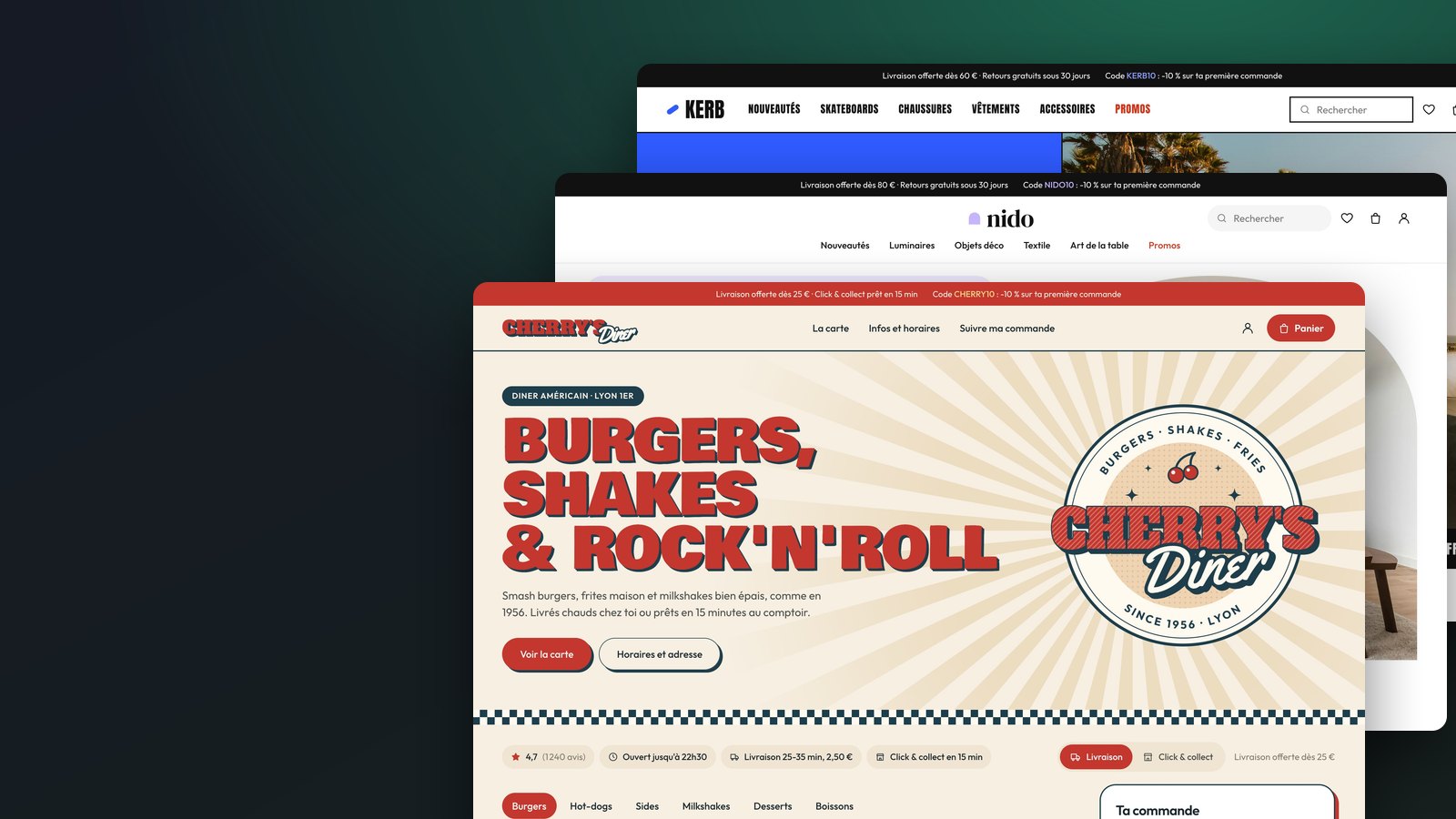
The platform had to meet the needs of several brands and businesses, without multiplying technical solutions. Until then, every new brand meant specific development work, while the back office held back the efficiency of operations.
The redesign rests on a shared base, designed to adapt to the specifics of each business and deliver distinct experiences.
From order management to the purchase journey, features are shared while building in the rules specific to each business. The platform can thus take on new brands more easily, without starting from scratch.
- Role
- Design and prototyping: back office, conversion funnel, art direction of the five storefronts, shopping and ordering journeys, theme integration.
- Duration
- 4 months
- Team
- 1 product designer, 1 product manager, 2 developers
- Context
- Redesign of an e-commerce platform: the same back office for every shop and a customisable storefront, rolled out for five brands.
Impact
- −60%time to launch a new shop
- +18%conversion
- −35%order handling time
01Running the business
See what matters, act right away.
Before the redesign, the dashboard showed four metrics with no comparison. Analysing a period meant typing the dates in by hand, and the information gave no quick way to spot situations that needed action.
The new dashboard brings together the shop’s four key metrics: revenue, number of orders, average order value and conversion rate. Each metric can be compared with the previous period, from a single day to a full year.
Operational alerts are also available as soon as the dashboard opens: pending payments, payment errors, out-of-stock items and low stock levels. Each alert leads straight to the items concerned.
Handling orders more efficiently
Previously, handling an order took several steps: opening a dedicated page, going through several blocks of information to reach the status, then returning to a list that had lost its filters.
The new interface lets you filter orders by status and go straight to the ones that need handling. A side panel brings together the essentials: customer details, address, items and amounts.
Managing products as they are actually sold
Catalogue management takes the specifics of each business into account. Putting products online, taking them offline, stock management by option and availability alerts are all available from the admin screens.
Tax rules are adapted to each business: 20% VAT for fashion and home decor, 5.5% for the delicatessen and 10% for the restaurant.
02Improving conversion
Understand drop-offs. Find the levers.
Previously, conversion tracking came down to a single overall figure. Analysing drop-offs and following up with customers took several manual steps and tools.
The new dashboard breaks down every step of the purchase journey and compares performance with the previous period.
Friction points are identified from concrete data: unavailable products, carts close to the free-delivery threshold or declined payments. Abandoned carts can also be followed up right from the interface.
03Tailoring the experiences
A shop in each brand’s image
Each brand has its own visual identity: colours, typefaces, home page composition and choice of imagery.
Components are built on a shared library, but their look, composition and use are adapted to each brand’s world.
Separating visual identity from technical architecture means a new shop can be launched without rebuilding its storefront.
A journey tailored to each product
Product characteristics determine the choices offered at purchase. The journey therefore has to adapt to each catalogue, without forcing the same experience on every brand.
Restaurants, without bending the model
The e-commerce base accommodates the specifics of restaurants, without carrying over the constraints of a traditional shop.
Product variants become meal options: the dish on its own or as a combo. Delivery methods include click & collect, while the pickup or delivery slot replaces the shipping time.
Order tracking follows four steps that match how the restaurant works, from preparation in the kitchen to handover at the counter or delivery.
Several experiences. One mobile standard.
All shops have a mobile version designed for a 375 px screen, with no horizontal scrolling.
Interactions are also adjusted to the format and the context of use.
04Standardising the base
Standardise the base. Preserve differentiation.
The platform rests on a distinction between shared features and the settings specific to each business.
Catalogue, orders, payments, stock and reporting tools make up the shared functional base.
Product attributes, commercial rules, workflows and visual identities are configured to suit the needs of each brand.
This architecture pools development work and lets several shops evolve from a single technical product, without multiplying independent solutions.